








Using SAP Opportunity Assessment to turn risk insight into business value
-
Risk insights can reveal opportunities to improve processes, systems, and assets when organizations look beyond control and mitigation alone.
-
SAP Opportunity Assessment provides a structured way to evaluate, prioritize, and pursue opportunities, but it is often unused.
-
Realizing its value requires leadership, clear ownership, agreed evaluation criteria, and collaboration between risk teams and the wider business.


23 Nov, 2026 — 6 min read
Table of contents
What if the risks already visible in SAP Risk Management could tell you more than where another control is needed?
Most organizations use SAP Risk Management for a clear and important purpose: to identify exposure, meet governance and compliance requirements, and ensure risks are assessed and controlled. That focus is understandable, but it can leave part of the platform untapped. SAP Risk Management ships with both Risk Assessment and Opportunity Assessment, yet many teams concentrate on the former without exploring how the latter could help them act on what their risk insights reveal.
Risk management protects the value an organization already has, while opportunity management focuses on where new value can be created. By looking beyond control and mitigation, organizations can use those insights to identify opportunities to improve processes, make better use of assets, and support growth. That shift requires leadership, ownership, and collaboration, with SAP Opportunity Assessment providing a structured way to evaluate and pursue the opportunities that emerge. In this blog, we’ll explain why Opportunity Assessment is often overlooked, how a broader view of risk makes it relevant, and what leaders need to put in place to use it effectively.
Why Opportunity Assessment is so often overlooked
In practice, many SAP Risk Management implementations concentrate on Risk Assessment. It receives the key risk indicators, response plans, controls, and reporting. Meanwhile, Opportunity Assessment remains untouched.
There are understandable reasons for this imbalance. Compliance and audit requirements often determine the scope and funding of a risk implementation, while opportunity identification may already sit with strategy, innovation, or another part of the business. Adding another process can appear duplicative when ownership is unclear and implementation time and budget are limited.
The way organizations think about risk reinforces this pattern. Risk management’s immediate priority is to protect existing value by reducing the likelihood or impact of adverse events. That work gives the business an essential foundation, but teams can become so focused on controlling each issue that they never consider whether a recurring risk points to a wider opportunity for improvement. Opportunity Assessment can therefore become the capability nobody configured, rather than one the organization consciously rejected.
Using risk insights to identify opportunities
To understand how risk insights can uncover opportunities, start with the recurring risks already visible in SAP Risk Management and look beyond the immediate control response.
Consider a manual financial reporting process in which the error rate is rising, for example. A traditional risk response might introduce additional controls, increase the number of reviews, or carry out more checks. Those measures may reduce the immediate risk, but they do not address its underlying cause: a manual process that remains prone to error.
Viewed through an opportunity management lens, the same issue suggests another course of action: automating the reporting process and improving the underlying data model. An enhancement plan could define the actions, ownership, and timeline required, with expected benefits such as fewer manual errors, faster reporting, and better-quality data. Pursuing the opportunity would therefore help reduce the related risk while delivering wider business benefits.
This does not mean that the risk itself has become an opportunity, or that every risk will reveal one. Risk management and opportunity management remain separate but complementary disciplines — one protects existing value, while the other considers where that value could be enhanced or where new value could be created. Their relationship becomes useful when decision-makers use a visible risk to ask whether the underlying process could be improved, an underused asset could create more value, or a different approach could remove the source of the problem. Bringing those questions into risk discussions helps the organization consider how its existing insights could support improvement and growth.
How Opportunity Assessment supports the shift
Once leaders begin asking those broader questions, Opportunity Assessment gives the resulting discussion a defined structure. An organization can record an opportunity, evaluate its probability and expected benefit, and create enhancement plans that describe the actions, owners, resources, and timelines needed to pursue it. Comparing the opportunity before and after those planned enhancements can help decision-makers consider whether the expected value justifies the investment.
This structured process provides a documented basis for comparing opportunities, deciding which ones merit funding, and monitoring whether the expected benefits are being realized. Of course, SAP does not replace business judgment, particularly when benefits are difficult to quantify, but it can make the reasoning and assumptions behind a decision more consistent and visible.
Organizations do not have to manage every opportunity in SAP, especially when an effective process already exists elsewhere. If your organization already uses SAP Risk Management, however, Opportunity Assessment is worth examining because it may provide the structure needed to connect risk insight with wider investment and improvement decisions.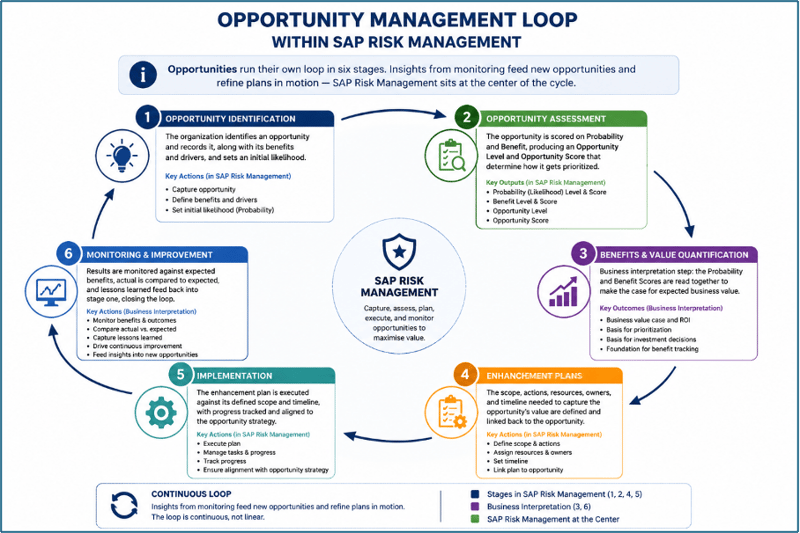
Creating the conditions to use Opportunity Assessment effectively
Putting opportunity management into practice requires leaders to decide:
- Who owns the Opportunity Assessment process.
- How opportunities enter it.
- Which criteria will be used to assess probability and benefit.
- Who can approve funding.
- How results will be monitored.
The people involved also need enough knowledge of the business to distinguish a credible opportunity from an optimistic projection.
Collaboration is equally important because the risk team may identify the recurring issue while another function owns the process, asset, or investment decision. Bringing those perspectives together at the decision level through Opportunity Assessment allows each discipline to retain its purpose while contributing to a fuller view of the issue.
As with any new project, it’s best to begin with a small-scale pilot. A practical starting point is to review recurring risks and ask whether any of them point to an underlying process, system, or asset that could be improved. If a credible opportunity emerges, the business can test the approach on a limited scale by defining an owner, assessing the potential benefit, agreeing an enhancement plan, and monitoring the result before extending the model more widely.
Finding value in the risks you already see
As security becomes a closer partner to the business, risk management can contribute more than a record of threats and controls. Its insights can help leaders recognize where existing processes are holding the organization back and where a different response could improve performance or support growth.
For leaders, this means looking within the risk information and tools already available and asking whether recurring issues point to well-founded opportunities for improvement. If they do, Opportunity Assessment offers a structured way to evaluate those possibilities and decide which ones are worth pursuing, allowing risk management to continue protecting existing value while the business acts on opportunities to create more.